Anthropology is a formal discipline that seems to affect some by awakening a spiritual sensitivity. Whether secular scientists or humanists, the anthropological ethic transcends the skepticism of agnostic secularism, by offering a alternative way to understand and accept the human condition.
To accept the anthropological ethic doesn't require the individual to be exposed to a professionally trained academic, or applied anthropologist. One can come to the discipline through introspection and informal contact with the anthropological legacy.
For these individuals, converted by the unique perspective that anthropology gives them to the human condition, it comes from a melding of humanistic science with scientific humanism. This melding transcends the tribally bound tradition of their sectarian belief systems. This perspective forms the foundation for the "career" anthropologist - the individual who lives his/her life based upon the anthropological ethic.
Not all anthropologists share this view. Some feel that only the anointed, PhD academic researcher qualify for sainthood. Others would extend the inner circle to those who teach and hold the precious PhD degree. Still others, more liberal in their theology, would extend membership to those who apply their formal anthropological training in the real world and are paid to do so -- i.e. professionals. These "conservatives" forget, if they ever knew, that at one time, none of these priestly professional classes existed in American before 1879.
The early western "anthropologists" came to their conversion through an interest, curiosity and secular acceptance of the principle of human universality often found in their own sectarian religious beliefs, but more often ignored in practice by their coreligionists. It was a conversion that came when the formal traditional ethic failed to explain to reality of life as experienced through day to day living. It cames from accepting the relativity of life, as explained by cultural differences, as against the absolute certainty imposed by religious and traditionalist formalities. For these emergent "anthropologists," this new ethic was based on the avocational pursuit of personal curiosities, interests and enlightenment rather than any vocational or professional desire for personal financial enrichment.
Today, we have a cast and class structure within anthropology. It is a system which draws a line between the academic caste and other professionals, on the one hand, and between the vocational or "professional" (class) and the avocational anthropologists, on the other.
In my mind, these are false distinctions which, unfortunately, have real negative consequences for individuals and the discipline. The true distinction between anthropologists and the general population should be based on the matter of commitment to the anthropological ethic. Such a commitment leads to a CAREER ANTHROPOLOGY. A career anthropologist is one who lives a life based on the core values of anthropology regardless of the financial rewards or costs of such a commitment.
What is this core ethic?
As I look back on the events of my life since I first encountered "anthropology" in the early 1960s; and I consider the path that I have wandered since then, I find a singular consistency. That consistency is found in the original anthropological perspective which I have come to call the Boasian Principles. These are the principles that lead to a "Career anthropological" ethic.
As an ethic for anthropology, Boas and his students established a set of 11 informal rules for anthropology. As the founder, and “god-head” of American anthropology, Franz Boas' principles became the normative ethic for future generations of American anthropologists. The 11 Rules of an Boasian Anthropological ethic form a American anthropological tradition and ethic.
These rules are:
1. a combination of humanistic and scientific values;
2. a focus on the concept of culture;
3. an emphasis on non-literate, small scale sociocultural systems as the subject of study;
4. a holistic perspective in the study of sociocultural phenomena;
5. a reliance on the comparative method of analysis;
6. a tradition of employment in a research setting associated with a museum or university;
7. an orientation toward historical particularism, i.e. understanding the role and function of sociocultural phenomena in context;
8. a tradition of participant-observation in a personal field work experience;
9. the ideal of the scientific role as a standard for judging professional status;
10. an objective and relativistic moral and ethical position;
11. a four field approach in the basic training of recruits to the profession and in the organization of the profession. (Bainton 1979: 127 - 128)
Even in our deeply segmented 21st century discipline, I find it amazing how well these rules have held up. Despite the monumental changes that have taken place in the social sciences and in the world at large, I find that most of these principles as valid today as they were when first established. However, I question the sixth principle which imposes a limitations on employment to a university or museum setting. This is like condemning all Christians or Buddhists to a lifetime in the monastery.
The strength and longevity of any belief system, philosophical or religious, rests in its practical application by providing a method for answering the questions of daily life for the individual and the community of believers.
With the exception of the sixth principle, I find this in the Boasian ethic. I have learned that we do not need to pursue our careers in the museum and/or the university even as these are still the ideal our teachers and mentors hold up to the aspiring student. But we can perform the functions that these metaphors represent by choosing to become Career Anthropologist and applying the Boasian ethic.
What has been your experience?
Monday, November 7, 2011


Thursday, October 13, 2011
Suppose They Began the Twenty-First Century and Forgot to Invite Anthropology
In 1973, Thomas Weaver of the University of Arizona organized a symposium in conjunction with the American Association for the Advancement of Science meetings to be held in San Francisco in February 1974. The theme/ title, "Anthropology in the 1990's: Conditions, Needs, and Prospects." with the subtitle "Suppose They Began the Twenty-First Century and Forgot to Invite Anthropology!!!" One of the people Weaver called upon was Dr. Edward H. Spicer, a fellow colleague from the University of Arizona and the President of American Anthropological Association, for his observations and thought about the future for cultural anthropology.
As reported by his widow in 1994, (Spicer, Rosamond 1994 Human Organization, Vol. 53. No. 4, pp. 388 - 395), Spicer took the assignment with the same degree of seriousness and dedication that he had displayed through out his professional career. He saw it as an opportunity to share his thoughts and impressions of the profession and in particular, to speculate on where he saw the profession going. On February 28, 1974, he presented his paper entitled, "Anthropology in the society of the 1990s".
Edward H. Spicer was a both a humanist and scientist whose work spans the traditional four field of anthropology, and who played a significant role in the formation and development of the fifth field, Applied Anthropology. Spicer taught those of us fortunate to be his student to appreciate and understand the connection between a people’s past, their present, and how these shaped their future. In his paper on that February day in 1974, he outlined 5 trends in the social and cultural environment that he felt would shape the next 20 years for professional anthropology.
Twenty years later, in 1994, the paper was republished in Human Organization with a forward by his widow, Rosamond Spicer, under the title, "Reassessing Edward Spicer's Views on Anthropology in the Society of the 1990s: How and Why This Paper by Edward H. Spicer Was Written" From her forward, we can gain an insight into Ned's thinking and approach to the future.
In 1974, Spicer envision five major societal trends that would impact the development of the profession leading toward the 1990s were the following:
(1) increasing intercommunication among the peoples of the world;
(2) increasing occupational specialization with accompanying organic differentiation within societies;
(3) increasing failure of technological solutions for the resolution of human problems in acceptable ways;
(4) increasing assertion and self-expression of ethnic groups within nation-states; and
(5) increasing reaction against centralization in political and administrative structures.
He stated "In general, continuation of these trends will, I believe, result in a society more heterogeneous than it was in the 19th or any previous century, more aware of its heterogeneity, with stronger than ever tendencies to compartmentalization, with increased awareness of and interest in non-technological and non-economic factors affecting human life, and with a growing tendency to view the nation-state in a wholly new light, especially with reference to its ethnic components and its political and administrative units." (p. 389)
Now nearly 40 years later, it might be worth considering just how prescient Ned’s predictions were for the 1990s and for the 21st Century.
Was he right? Partially right? Or, Did he miss the mark?
What are your thoughts?
As reported by his widow in 1994, (Spicer, Rosamond 1994 Human Organization, Vol. 53. No. 4, pp. 388 - 395), Spicer took the assignment with the same degree of seriousness and dedication that he had displayed through out his professional career. He saw it as an opportunity to share his thoughts and impressions of the profession and in particular, to speculate on where he saw the profession going. On February 28, 1974, he presented his paper entitled, "Anthropology in the society of the 1990s".
Edward H. Spicer was a both a humanist and scientist whose work spans the traditional four field of anthropology, and who played a significant role in the formation and development of the fifth field, Applied Anthropology. Spicer taught those of us fortunate to be his student to appreciate and understand the connection between a people’s past, their present, and how these shaped their future. In his paper on that February day in 1974, he outlined 5 trends in the social and cultural environment that he felt would shape the next 20 years for professional anthropology.
Twenty years later, in 1994, the paper was republished in Human Organization with a forward by his widow, Rosamond Spicer, under the title, "Reassessing Edward Spicer's Views on Anthropology in the Society of the 1990s: How and Why This Paper by Edward H. Spicer Was Written" From her forward, we can gain an insight into Ned's thinking and approach to the future.
In 1974, Spicer envision five major societal trends that would impact the development of the profession leading toward the 1990s were the following:
(1) increasing intercommunication among the peoples of the world;
(2) increasing occupational specialization with accompanying organic differentiation within societies;
(3) increasing failure of technological solutions for the resolution of human problems in acceptable ways;
(4) increasing assertion and self-expression of ethnic groups within nation-states; and
(5) increasing reaction against centralization in political and administrative structures.
He stated "In general, continuation of these trends will, I believe, result in a society more heterogeneous than it was in the 19th or any previous century, more aware of its heterogeneity, with stronger than ever tendencies to compartmentalization, with increased awareness of and interest in non-technological and non-economic factors affecting human life, and with a growing tendency to view the nation-state in a wholly new light, especially with reference to its ethnic components and its political and administrative units." (p. 389)
Now nearly 40 years later, it might be worth considering just how prescient Ned’s predictions were for the 1990s and for the 21st Century.
Was he right? Partially right? Or, Did he miss the mark?
What are your thoughts?
Friday, September 16, 2011
How do we measure culture -- a layman's approach
Culture is a difficult concept even among anthropologists because we all have our own way of trying to define and describe it. Yet, there are certain features of the phenomena which are objective. And from an economist's or other social scientist's point of view, it can be measurable
Defining Culture
1. Culture is a product of social/collective behavior.
2. Culture is the result of human activity that organizes the environment into meaningful units for the members of society.
3. Culture is a learned and shared set of meanings passed on from generation to generation (generation here can be biologically or socially defined).
4. Culture is the unifying force that binds generations and individuals together into social groups for collective purposeful action.
5. Culture has both a material and a metaphysical substance.
a. The material is what is found in an archaeological site or simply observed in the material world in which people interact.
b. It is metaphysical in the sense that there is a unique set of purposeful meanings for carrying out and achieving the social goals that are shared and understood by the members of the social system.
Macro and Micro Cultural Measurement
Culture can be measured on the macro scale in terms of energy use and efficiency to achieve culturally defined purposes. A culture can be compared to another culture if we are talking about the same purpose. For example: Using man hours and calories per person as the metric, two cultures might be compared in terms of the number of man hours required to produce a week's worth of food to insure that each person has the opportunity of obtain 1500 calories per day.
Culture is measured on the micro-level using the anthropological approach. This is done by looking at ALL of the human and societal activities that the culture demands to achieve the purpose -- not just money and labor but also government activity, social recruitment, organization and behavior to implement the activity and its management, religious sanctions and interpretations of the rightness of the activity, family and individual resources and commitments required to participate in the process. These activities are largely organized as traditions that are passed down from generation to generation. For example, how your mother puts together your favorite meal which she learned from her mother and she from her mother.
Measuring Culture from the applied anthropologist's perspective
Over the past forty years I have been defining culture from the applied anthropological perspective. These are the steps that I find work, if the client is serious about solving the problem. That is, by serious I mean that the client is prepare to pay for the service, and dedicate time and effort to solving it.
When I have been asked to help solve a client's problem, I always begin by studying my client's current practices and their behaviors associated with "the problem". First, I observe and record what they are doing and watch to see where there is a problem or if the problem is really a problem and not just a symptom of something bigger.
Then I ask them " Why do you think this is a problem?" and "Why do you do what you are doing?" That is, I ask them to explain what they are doing and why? I want to know what their meanings are for doing things that are creating their problem.
Once I understand that, I can then discuss what it is they think they are doing and what it is they want to do.
After this, and only after this, can we begin to look for metrics to measure what it is that they real want to do or achieve.
Metrics are Cultural Phenomena
The metric is the cultural phenomenon -- it is how the client values the activity and its outcome. If I impose my own metric, it may become interesting to me and my colleagues, but be meaningless to the client.
Econometric models are interesting to economists and some policy makers and totally meaningless to the general public who are asked to respond to the results of the analysis. The results have to be translated into meaningful, i.e. culturally relevant, policies.
Defining Culture
1. Culture is a product of social/collective behavior.
2. Culture is the result of human activity that organizes the environment into meaningful units for the members of society.
3. Culture is a learned and shared set of meanings passed on from generation to generation (generation here can be biologically or socially defined).
4. Culture is the unifying force that binds generations and individuals together into social groups for collective purposeful action.
5. Culture has both a material and a metaphysical substance.
a. The material is what is found in an archaeological site or simply observed in the material world in which people interact.
b. It is metaphysical in the sense that there is a unique set of purposeful meanings for carrying out and achieving the social goals that are shared and understood by the members of the social system.
Macro and Micro Cultural Measurement
Culture can be measured on the macro scale in terms of energy use and efficiency to achieve culturally defined purposes. A culture can be compared to another culture if we are talking about the same purpose. For example: Using man hours and calories per person as the metric, two cultures might be compared in terms of the number of man hours required to produce a week's worth of food to insure that each person has the opportunity of obtain 1500 calories per day.
Culture is measured on the micro-level using the anthropological approach. This is done by looking at ALL of the human and societal activities that the culture demands to achieve the purpose -- not just money and labor but also government activity, social recruitment, organization and behavior to implement the activity and its management, religious sanctions and interpretations of the rightness of the activity, family and individual resources and commitments required to participate in the process. These activities are largely organized as traditions that are passed down from generation to generation. For example, how your mother puts together your favorite meal which she learned from her mother and she from her mother.
Measuring Culture from the applied anthropologist's perspective
Over the past forty years I have been defining culture from the applied anthropological perspective. These are the steps that I find work, if the client is serious about solving the problem. That is, by serious I mean that the client is prepare to pay for the service, and dedicate time and effort to solving it.
When I have been asked to help solve a client's problem, I always begin by studying my client's current practices and their behaviors associated with "the problem". First, I observe and record what they are doing and watch to see where there is a problem or if the problem is really a problem and not just a symptom of something bigger.
Then I ask them " Why do you think this is a problem?" and "Why do you do what you are doing?" That is, I ask them to explain what they are doing and why? I want to know what their meanings are for doing things that are creating their problem.
Once I understand that, I can then discuss what it is they think they are doing and what it is they want to do.
After this, and only after this, can we begin to look for metrics to measure what it is that they real want to do or achieve.
Metrics are Cultural Phenomena
The metric is the cultural phenomenon -- it is how the client values the activity and its outcome. If I impose my own metric, it may become interesting to me and my colleagues, but be meaningless to the client.
Econometric models are interesting to economists and some policy makers and totally meaningless to the general public who are asked to respond to the results of the analysis. The results have to be translated into meaningful, i.e. culturally relevant, policies.
Tuesday, August 30, 2011
Anthropology and Consumer Resaerch -- An applied paradigm
Robert Tian, Business Anthropology, Anthropology of Business Blog, makes a good point about the technological overload that is emerging in the consumer research field. Data, tonnes of data, will be available and are available about consumer behavior. It is becoming available in real time to marketers and business strategists. But what does it mean? This is where the anthropologist, strategically positioned in the supply chain and in the corporation, has an advantage. The gathering of market data is the same as international espionage and we all know how good that process works, especially when it is stove-piped.
Anthropology is more than participant observation. Go back to the Boasian protocol and you will see that a holistic, comparative, and historically/environmentally contextual approach to the data -- confirmed through participant observation is the heart of the anthropological analysis. We go through so many fads and linguistic games to be unique that nobody, least of all many of our colleagues, know what anthropology really is and what an anthropologically trained person can do.
An effective strategy for the business anthropologist is to become the data consolidator and interpreter for the business owner, or the client. While David describes what can be collected, he did not explain how this can be used in anyway different from what is now being done, only more detail. Anthropology can provide another interpretive paradigm linked to the broader business context - such a market trends, disruptions and discontinuities. But this requires some new thinking within anthropology as well as within the business community. Maybe this more than most would be willing to attempt.
The easy escape for the anthropologist interested in consumer behavior is to try to retreat to the academy or museum -- the ancestral nurturing grounds of anthropologist -- and avoid the real world. However, like the sparrow fledgling popping out of our bird house this past June, you have to learn to spread your wings and take chances with the equipment you have been given and are trained in if you want to get over to the bird feeder with the big boys/girls..
As an applied anthropologist, in the consumer research field, It is what you can do for the client or employer that counts -- not the brand name "anthropology" -- which counts. The paradigm is: 1. Do a good job selling your abilities to solve the client's or employer's problem; 2.Create value for them; and then, 3.. Sell the brand, Anthropology. This will give it meaning.
Right now accounting and law have created a proven brand and therefore command a premium price. Anthropology is still Indiana Jones and Bones, "rocks and bones." Today it only commands a generic researcher's price. Show the business world how it can use anthropological skills, profitably, and how to get value from all that data they are buying, then anthropology will become a brand. And the Consumer Anthropologist will command a premium price for his/her services.
Basic principle: Prove the product and give birth to a brand. Not the other way around.
Anthropology is more than participant observation. Go back to the Boasian protocol and you will see that a holistic, comparative, and historically/environmentally contextual approach to the data -- confirmed through participant observation is the heart of the anthropological analysis. We go through so many fads and linguistic games to be unique that nobody, least of all many of our colleagues, know what anthropology really is and what an anthropologically trained person can do.
An effective strategy for the business anthropologist is to become the data consolidator and interpreter for the business owner, or the client. While David describes what can be collected, he did not explain how this can be used in anyway different from what is now being done, only more detail. Anthropology can provide another interpretive paradigm linked to the broader business context - such a market trends, disruptions and discontinuities. But this requires some new thinking within anthropology as well as within the business community. Maybe this more than most would be willing to attempt.
The easy escape for the anthropologist interested in consumer behavior is to try to retreat to the academy or museum -- the ancestral nurturing grounds of anthropologist -- and avoid the real world. However, like the sparrow fledgling popping out of our bird house this past June, you have to learn to spread your wings and take chances with the equipment you have been given and are trained in if you want to get over to the bird feeder with the big boys/girls..
As an applied anthropologist, in the consumer research field, It is what you can do for the client or employer that counts -- not the brand name "anthropology" -- which counts. The paradigm is: 1. Do a good job selling your abilities to solve the client's or employer's problem; 2.Create value for them; and then, 3.. Sell the brand, Anthropology. This will give it meaning.
Right now accounting and law have created a proven brand and therefore command a premium price. Anthropology is still Indiana Jones and Bones, "rocks and bones." Today it only commands a generic researcher's price. Show the business world how it can use anthropological skills, profitably, and how to get value from all that data they are buying, then anthropology will become a brand. And the Consumer Anthropologist will command a premium price for his/her services.
Basic principle: Prove the product and give birth to a brand. Not the other way around.
Saturday, July 23, 2011
Why we need an Applied Anthropology - 2!
The real world of a global economy controlled by small "tribal" elites requires the study by those who have the broad anthropological perspective and the skills of participant observation. Case in point:
See the book Liquidation..
When the incentive system is out of synch with the superorganic (social and cultural) purpose of the activity that drives the system, then we get melt down or cancer. Crisis is the result of systemic conflict and mismatches. Anthropology teaches us that there is no institution, no tribe, no nation and no civilization that is NOT TOO BIG TO FAIL. Applied anthropologists have a lot to contribute to understanding this and the processes that affect it. Here is a good example of what anthropologists can do to address the problem.
See the book Liquidation..
When the incentive system is out of synch with the superorganic (social and cultural) purpose of the activity that drives the system, then we get melt down or cancer. Crisis is the result of systemic conflict and mismatches. Anthropology teaches us that there is no institution, no tribe, no nation and no civilization that is NOT TOO BIG TO FAIL. Applied anthropologists have a lot to contribute to understanding this and the processes that affect it. Here is a good example of what anthropologists can do to address the problem.
Monday, July 18, 2011
How the American Anthropological Association got Ethics wrong
For more than 40 years (1970 - 2010), the American Anthropological Association has struggled with the question of professional ethics. In the early 1990s, the Executive Board of the AAA established a Commission to look into the question of professional ethics. "The AAA Executive Board charged the Commission to Review theAAA Statements on Ethics to examine the purposes, content and procedures of the Association Statements on Ethics."
To its credit the Commission outlined the problems that it found while the trying to address the problem. The Commission, in its report, lays out a set of "General Principles Applying to Codes of Ethics." These principles were, and are, however, critically flawed. And because they are, the Commission perpetuated the major flaw in the profession's thinking about ethics and especially professional ethics.
To date anthropologists have failed to distinguish between what are “professional” ethics and what is "religious orthodoxy" or "disciplinary dogma." By “professional ethics” I mean, "What are the moral rules that apply to the unique role of being a professional anthropologist; that is, one who earns their living practicing the discipline of anthropology." By “religious orthodoxy,” I mean those claims to some divine, universal revelation of what any anthropologically trained individual is expected to do in all aspects of their personal and public life.
Anthropologists have failed to apply their own disciplinary rules and principles to study this very cultural of phenomena; nor have they applied the results of such study to the problem's solution. It is by examining these General Principles and evaluating them in terms of anthropological and sociological principles that we can find the fatal flaw in the profession's reasoning as expressed by the Commission report.
In the analysis below the Commission's key principles are numbered and are presented in italics along with my comments in non-italic form on each major principle.
.III. General Principles Applying to Codes of Ethics
In reviewing the purpose and content of a Code of Ethics, the Commission profited from discussions with Bernard Gert, Professor for the Study of Ethics and Human Values, Dartmouth College. Professor Gert provided some general guidelines for developing a disciplinary and professional code of ethics. By way of background, the Commission lists some of those guidelines, some of which were drawn from "Morality, Moral Theory, and Applied and Professional Ethics," (Gert, Professional Ethics, Vol. 1, Nos. 1 & 2, 1992.)
1. The primary purpose(s) of a professional code of ethics is to help educate and socialize new entrants to the field as well as current members of the discipline; therefore, a code must be of some practical use.
The primary purpose is not to educate new entrants, rather it is set the moral and ethical context/constraints that govern professional behavior of those who claim or are certified as professionals in the discipline. A code of ethics is a social contract and therefore is a statement of the collective beliefs of the membership and the standard by which members evaluate one another’s behavior and enforce a collective standard. Certainly neophyte require training and indoctrination -- but only if it is to be meaningful upon completion of their initiation.
The primary purpose of a professional Code of Ethics is to present to the society, of which the profession is but a part, a clear statement of the purpose and mission of the profession as it applies to its relation to the community at large.
2. A professional code deals with how a person ought to act, and with behaviors required by one's societal role/job. A code of ethics does not define a person's job or professional title (that is, a code of ethics does not define terms such as "scientist," "humanist," or "anthropologist ").
This is a contradictory statement to say the least, and very poor social anthropology at its worst. If the code deals with “how a person ought to act” then it is describing an ideal “role.” That means, it is MUST, by definition, define a person’s professional role -- regardless of the job or professional status. “Ethics” is about behavior, not a structural position in a social network.
“Professional” is about status in the social network. It is a status, which comprises the membership of the practitioners trained in the body of skills and knowledge that make up the discipline. Thus, unless the Code does define what that discipline is and who is included and who is excluded, it fails the test of being professional.
3. The development of a code of ethics assumes that the majority of persons affected by the code agree that there are shared ethical principles; that is, "for the overwhelming majority of cases, any equally informed, impartial, rational person would come to the same conclusion " in determining a particular course of action
.
How does one determine what a majority is when there is no boundary established for inclusion and exclusion? Based on this definition, the population of the world is the universe. It would seem that the minority, anthropologists, do not constitute a majority to impose their standards on the world. Neither does it seem desirable that that be the case -- since the purpose of a professional code of ethics is to distinguish between what is “professionally” permissible behavior verses what is generally accepted as permissible behavior.
For example, an ordinary citizen will violate the law and morality by using deadly force against another person (Thou shall not kill). He or she is acting immorally/unethically to do so. However, a police officer, as a professional law enforcer, is ethically bound to use such force in self defense AND THE DEFENSE OF THE PUBLIC.
The reason for distinguishing between general/universal ethics and professional ethics is specifically to identify specialized domains of activity (disciplines) which society deems worthy of or which require special identification, and exemption from the general ethical responsibility and accountability that applies to general population. If this were not the case there would be no need for a separate and exclusive professional code.
4. A code of ethics is a "public moral system " in that (1) all persons to whom it applies, those whose behavior is to be guided and judged by that system, understand it, i.e., know what behavior the system prohibits, requires and encourages; and (2) it is not irrational for any of them to accept being guided or judged by."
I have no problem here because this assumption, or principle, addresses ethics in general. A personal, or even a public code of ethic, should be a public moral system which dictates how one behaves in public and toward others. However the phrase here is “all persons to whom it applies.“ A professional code does not apply to everyone -- it applies ONLY to those who are sanctioned by (1) the discipline, and (2) by the group that society sanctions to represent the discipline.
A public code of ethics is inclusive while a professional code of ethics is exclusive. As a citizen of the United States or the world, I am NOT bound by the AMA, nor the ABA, Codes of Ethics. However, I expect and demand that my doctor and my lawyer live up to their professional codes of ethics.
5. "A public moral system " includes rules, which must be followed (unless a violation can be justified), and ideals, which encourage how people ought to behave.
A “public moral system” consists of NORMS, not RULES as described here. NORMS are expectations of predictable behavior but not mandatory. RULES, as stated here, are LAWS which are mandatory and enforced by the society upon those over whom the society claims jurisdiction whether formally members of the society or not. “RULES” imply a formal process of enforcement, while NORMS only require an informal process. Breaking RULES carries consequences, breaking NORMS may carry shame or praise.
As applied by the American Anthropological Association and the Society for Applied Anthropology, the “public moral system,” which their Codes of Ethics claim to represent, is an “IDEAL” set of principles lacking any formal system or process of enforcement.
6. Moral rules are not absolute, but justified violations must be impartial (that is, every person may violate the rule in the same situation) and must be public (that is, everyone knows that the specific violation is permitted). It also is understood that there will be disagreement on what constitutes the "same situation."
Moral rules are “culturally” absolute. Moral norms are not. The allege violation is subject to question on two grounds. Was it a violation of a RULE or a NORM; and Did the circumstances of the alleged violation fall under the jurisdiction of the RULE?
If the alleged violation was the violation of a norm, then it is a relative violation in the sense that there may be a general agreement that something inappropriate happened but under the circumstances “we”, the public, can accept and forgive that it happened.
Rules are by definition RULES which are absolute. The question of whether there is a violation is not whether the violation is justifiable, it is whether the RULE applies under the alleged circumstances under which the alleged violation took place.
These are two different tests of the application of the ethical code, public or professional.
General conclusion: The rationale adopted by the Commission on Ethics reflects a decision made by a committee based on politics rather than a logical, "scientific" or "scholarly", assessment of the concept of ethics and its application to the discipline or profession. While the Commission raises a number of valid issues, the poor quality of their standards of reference lead it to produce a confused and loosely defined set of ethical and professional concepts. The final product fails to distinguish the differences between professional and public behavior.
As a result the Codes developed under these guidelines are over reaches their jurisdictional claims and otherwise hide the core ethical issues facing the profession. It is not that the Commission ignored, or even avoided, the conflict that such poorly defined principles reveal. It is that they did not see that the principles applied were flawed. As result, where there were differences in interpretation, the decision seems to have been made to achieve consensus, rather than validity or clarity.
Unfortunately, their recommendations appear to have been accepted by the AAA as guidelines for how and why the AAA is to construct its ethics code. As they state it, "..., the Commission's recommendation that the AAA focus on an ethics education program and no longer seek to adjudicate claims of unethical behavior has been adopted by the AAA Executive Board."
Today, if this is the case, we wonder why the AAA continues to concern itself with developing a theoretical code of ethics that, while idealistic, is not applicable to the profession or professionals? And further, how helpful can this be to train students, especially the majority of who will be going to work in the real world, to respond to the ethical challenges they will face in that world?
Tuesday, July 5, 2011
Why we need an Applied Anthropology
We live in a world which we know only as The World


click on the links below to learn more
It is a Beautiful World.

We share this World with millions of others people.

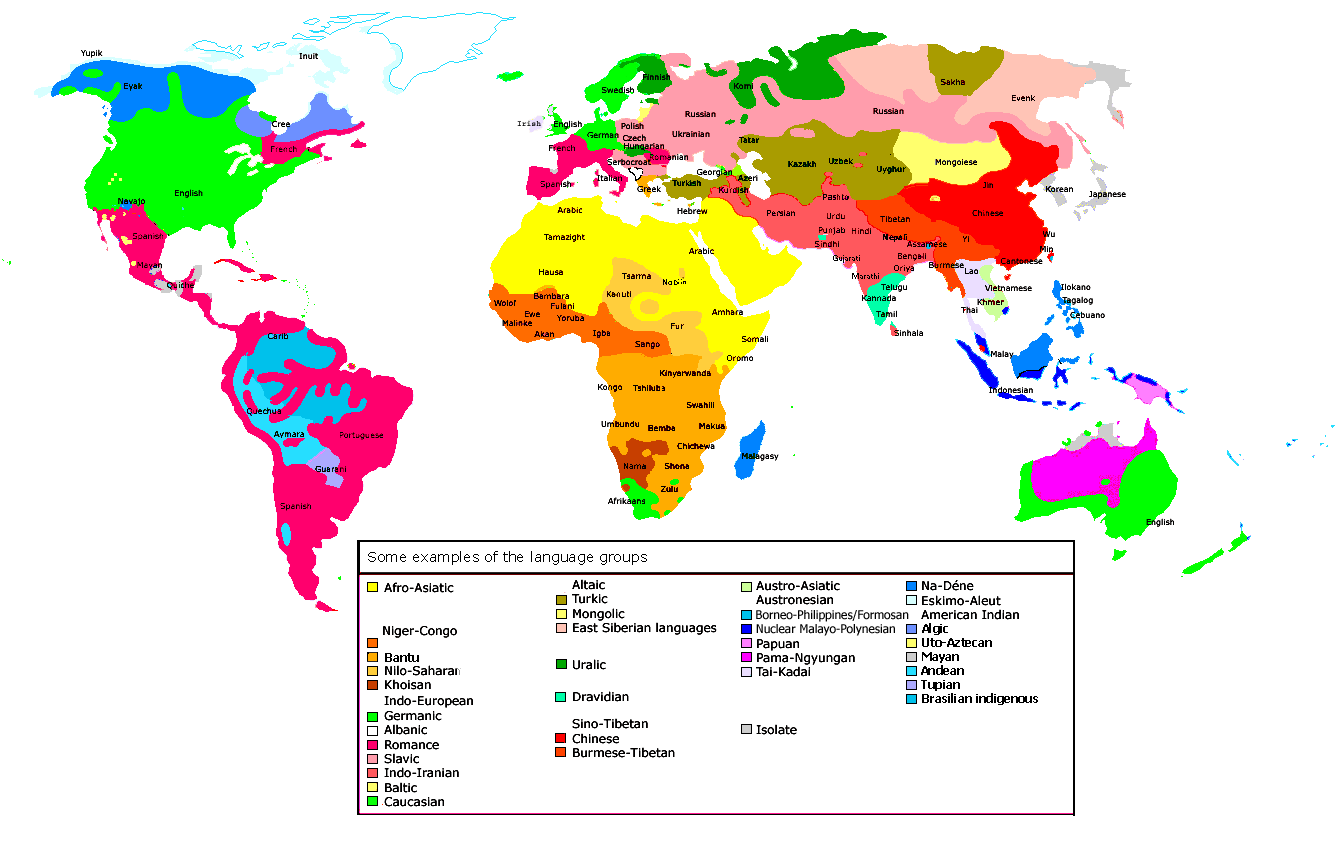

It is a fragile world that we almost destroyed at will during the post WWII Cold War
It is still happening. Do we want it to happen?
OR
How can we prevent this from happening???
We need to understand one another, our differences and our similarities. We need to be open minded and accepting if we are to survive as a species.
Applied Anthropology, the application of scientific knowledge about how our species has survived and prospered, is a starting point to framing the real questions facing our species in this century.
It is still happening. Do we want it to happen?
OR
How can we prevent this from happening???
We need to understand one another, our differences and our similarities. We need to be open minded and accepting if we are to survive as a species.
Applied Anthropology, the application of scientific knowledge about how our species has survived and prospered, is a starting point to framing the real questions facing our species in this century.
Subscribe to:
Posts (Atom)